

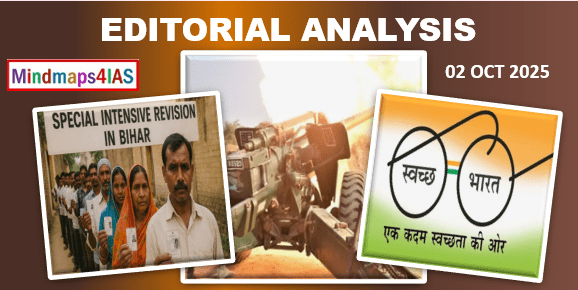
EDITORIAL 01
Fraught franchise: On a nationwide Special Intensive Revision exercise
Issue: The Election Commission of India (ECI) recently completed the Special Intensive Revision (SIR) of electoral rolls in Bihar, reducing the total number of electors from 7.89 crore to 7.42 crore.
While the stated goal was to clean and update voter rolls, the process and outcomes of the exercise have raised serious concerns about transparency, due process, and voter inclusion — especially after the Supreme Court’s intervention to correct procedural lapses.
Concerns from the Bihar Experience
Opaque Process and Lack of Transparency
- Around 65 lakh names were deleted citing reasons such as death, migration, duplication, and lack of enumeration.
- However, the ECI provided no consolidated list of excluded voters, issued no meaningful prior notice, and gave no individual reasons until directed by the Supreme Court.
Judicial Correction and Administrative Vagueness
- The Supreme Court insisted that reasons for deletions be made public, highlighting the lack of procedural safeguards.
- Even now, the ECI has not explained why 3.66 lakh names were removed between the draft and final rolls, or provided data on Form 6 additions and the count of alleged foreign nationals — the very justification for the SIR.
Disproportionate Impact on Vulnerable Groups
- Reports indicated that women’s names were deleted in disproportionate numbers, raising doubts about the accuracy and fairness of the exercise.
- Moreover, the ECI refused to accept widely held documents such as Aadhaar or ration cards, instead demanding birth certificates, caste, and domicile papers — documents often unavailable to the poor, women, Scheduled Castes, and OBCs.
Default Attitude of Suspicion
- The Bihar case reflects a presumption of ineligibility among voters rather than a facilitative approach. Such an attitude, if extended nationwide, could undermine the inclusiveness of India’s electoral democracy.
Need for Reform and Inclusive Practices
- Electoral management research, including that by the International Institute for Democracy and Electoral Assistance (IDEA), points to three global best practices that can enhance inclusion:
- Door-to-door verification by enumerators to complement self-reporting.
- Acceptance of widely held identity documents like Aadhaar and ration cards, minimizing exclusion due to lack of formal certificates.
- Advance publication of proposed deletions with an accessible appeals process.
- India’s earlier revisions in the 2000s relied more on Booth Level Officers (BLOs) and physical verification, which ensured accuracy without shifting the entire burden onto citizens.
- A national-level SIR could combine such human verification with digital tools to consolidate and publish exclusion data transparently, while ensuring physical notices at constituency level — striking a balance between transparency and privacy.
The Bihar SIR has exposed the fragile intersection between administrative efficiency and democratic inclusion.
While updating rolls is necessary, procedural opacity and rigid documentation norms risk disenfranchising millions of legitimate voters.
If extended nationally without reform, the same model could repeat Bihar’s exclusions on a massive scale.
To uphold India’s democratic spirit, the ECI must ensure that electoral integrity does not come at the cost of voter inclusion, reaffirming that the right to vote remains the cornerstone of citizen equality.
EDITORIAL 02
The battlefield, change and the Indian armed forces
PROVIDED TO PAID MEMBERS, IF YOU WANT CLICK HERE TO JOIN
EDITORIAL 03
On Gandhi Jayanti, remembering the promise of Swachh Bharat
PROVIDED TO PAID MEMBERS, IF YOU WANT CLICK HERE TO JOIN