

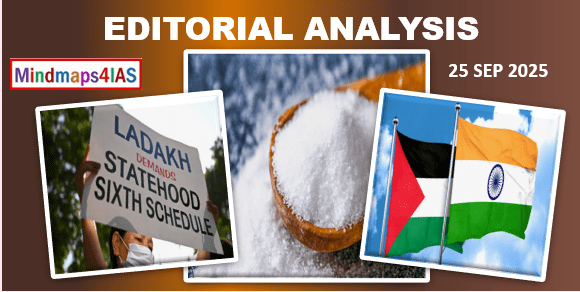
EDITORIALS FROM 25th Sep 2025
EDITORIAL 01
India’s muted voice, its detachment with Palestine
PROVIDED TO PAID MEMBERS, IF YOU WANT CLICK HERE TO JOIN
EDITORIAL 02
Just a pinch can reduce an Indian’s salt overload
Issue: India faces a rising burden of non-communicable diseases (NCDs) such as hypertension and cardiovascular diseases, with excess salt intake emerging as a silent but major contributor.
Indian adults consume 8–11 g/day, nearly double the WHO limit of 5 g.
What are the Concerns
- Dietary Patterns: 75% of salt intake from home-cooked food (pickles, papad, curries) + “hidden salt” in bread, snacks, sauces, processed foods.
- Cultural Practices: Salt shakers at dining tables, high salt use in restaurants, and rising High in Fat, Sugar, or Salt foods (HFSS) food consumption.
- Health Impact: 28.1% adults hypertensive; strong correlation with cardio-vascular diseases, stroke, kidney disease.
- Myths: Rock salt/pink salt wrongly perceived as healthier; often non-iodised → risk of iodine deficiency.
What Needs to be Done
- Policy Shift: Move beyond “sugar boards/oil boards” → adopt HFSS boards with equal focus on salt.
- Public Awareness: Promote gradual salt reduction, use of herbs/spices, low-sodium salt substitutes (with medical caution for kidney patients).
- Early Intervention: Prevent acquired salty taste; no added salt for infants/toddlers, reduce in children’s meals.
- Public Programmes: Set salt limits in mid-day meals, Anganwadi nutrition, hospital diets; train cooks and monitor standards.
- Regulation: Adopt front-of-pack labelling and salt ceilings in processed foods (Chile’s model); restrict HFSS marketing to children.
- Community Role: Restaurants to avoid salt shakers on tables; families to do weekly kitchen audits of HFSS foods.
- National Strategy: Strengthen NMAP for NCDs with multi-sectoral, cross-ministerial integration; embed salt reduction in existing health programmes.
Global & Economic Perspective
- WHO calls salt reduction a “best buy” intervention: $1 investment → $12 return in reduced disease burden.
- Successful examples: Chile & Mexico (warning labels, food reformulation) show measurable drops in salt intake.
Salt reduction is a low-cost, high-impact public health strategy. India must integrate regulation, awareness, and institutional reforms to curb salt intake and reduce NCD burden.
Without urgent action, the silent epidemic of high-salt diets will undermine India’s health gains and economic productivity.
EDITORIAL 03
About Ladakh protests demanding statehood, autonomy from Centre
PROVIDED TO PAID MEMBERS, IF YOU WANT CLICK HERE TO JOIN