

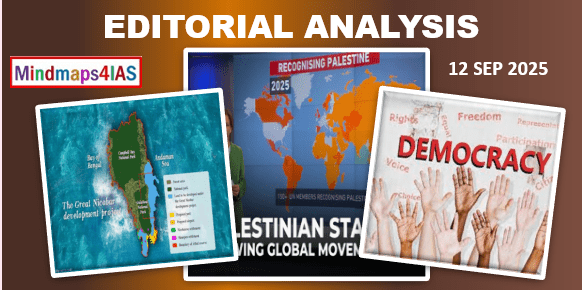
EDITORIALS FROM 12th Sep 2025
EDITORIAL 01
A project of a strategic and national importance
Issue: The Great Nicobar Island Project is a flagship initiative of the Government of India that seeks to transform Great Nicobar into a hub of maritime and air connectivity.
The project integrates an international container transhipment terminal (ICTT), a greenfield airport, a 450 MVA gas and solar-based power plant, and a township over 16,610 hectares.
It is a project of strategic, defence and national importance in the Indian Ocean Region.
Strategic & Developmental Features
- Maritime & Aviation Hub: ICTT with capacity of 14.2 million TEU, and a greenfield airport for global connectivity.
- Energy & Urban Infrastructure: 450 MVA power project and planned township development in three phases (2025–47).
- Employment & Growth: To generate jobs, support logistics, and enhance India’s blue economy prospects.
- Defence & Security: Strengthens India’s strategic presence in the Indian Ocean against growing geopolitical challenges.
Environmental & Tribal Safeguards
- Environmental Scrutiny:
- Detailed EIA and EMP prepared, including wildlife conservation and risk management.
- ₹55 crore already released for conservation plans even before construction.
- Tree felling capped; 65.99 sq. km retained as green area.
- Forest Diversion & Compensatory Afforestation:
- 75 sq. km (1.82% of A&N forest cover) diverted; compensatory afforestation to be undertaken in Haryana (97.3 sq. km identified).
- Wildlife Corridors:
- Viaducts proposed at 8 locations for safe animal movement.
- Studies by ZSI, BSI, SACON, WII ensure scientific baseline data for mitigation.
- Tribal Safeguards:
- No displacement of Shompens or Nicobarese; tribal consultation mandated.
- AAJVS, Ministry of Tribal Affairs, and Anthropological Survey involved.
- Net increase of 3.912 sq. km in tribal reserve after de-notification/re-notification process.
Policy Alignment & Institutional Framework
- Shompen Policy, 2015: Ensures welfare and integrity of PVTGs while allowing large-scale development with safeguards.
- Jarawa Policy, 2004: Recognises AAJVS as trustee for PVTGs.
- Constitutional Provision: Article 338A(9) ensures consultation with NCST on all matters affecting Scheduled Tribes.
- Empowered Committee Oversight: Cleared the project with assurance that tribal displacement will not occur.
Significance
- Strategic: Enhances India’s defence preparedness and maritime reach.
- Economic: Promotes trade, connectivity, and employment in the region.
- Ecological Balance: Incorporates afforestation, wildlife corridors, and conservation funding.
- Tribal Welfare: Safeguards Shompens and Nicobarese with consultative mechanisms and welfare budgets.
- Scale: Utilises only up to 2% of A&N’s total area, keeping ecological footprint limited.
EDITORIAL 02
Why are European nations now moving to recognise Palestine?
PROVIDED TO PAID MEMBERS, IF YOU WANT CLICK HERE TO JOIN
EDITORIAL 03
Nepal, France, America — democracy seems overtaken once more
PROVIDED TO PAID MEMBERS, IF YOU WANT CLICK HERE TO JOIN