

EDITORIAL 01
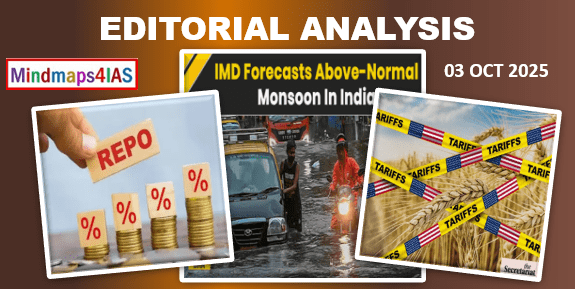
Changing the frame: On India, forecasting and natural events
PROVIDED TO PAID MEMBERS, IF YOU WANT CLICK HERE TO JOIN
EDITORIAL 02
RBI opts to wait as global uncertainties unfold
PROVIDED TO PAID MEMBERS, IF YOU WANT CLICK HERE TO JOIN
EDITORIAL 03
Dear Donald Trump, hear out Indian farmers
Issue: The story of a group of American students visiting a rural Indian village captures more than cultural curiosity — it reflects the deep structural divergence between the economies of India and the United States.
When children in a small Indian school asked why American farmers produce more, the answer lay not in effort but in resources, mechanisation, and economic structure.
This difference explains why Prime Minister Narendra Modi and U.S. President Donald Trump face contrasting domestic pressures: for India, agriculture is livelihood; for America, it is business.
About the Uneven Landscape of Agriculture
Agriculture in India is not merely a sector — it is a social safety net for nearly half the population.
- 45% of Indian workers depend on agriculture, contributing only 17% of GDP (World Bank).
- In contrast, the U.S. has less than 2% of its workforce in agriculture, which is highly mechanised and subsidised.
This means that any fluctuation in farm prices or trade tariffs affects hundreds of millions in India, while in the U.S., it impacts a small, well-organised interest group.
Consequently, India’s political red line in trade talks — particularly those involving agricultural imports — is grounded not in protectionism, but in economic survival and social stability.
What are the concerns with Tariff Negotiations?
- During recent tariff negotiations between India and the U.S., the opening up of India’s agricultural and dairy markets emerged as a sticking point.
- American negotiators sought access for U.S. farm products like wheat, soybeans, and dairy, backed by corporate-scale production and heavy subsidies.
- However, for India, agreeing to such terms would risk devastating consequences for smallholders already struggling under low productivity, fragmented landholdings, and uncertain market returns.
- Unlike U.S. farmers, Indian cultivators have limited access to credit, storage, and price assurance mechanisms.
- Thus, while the U.S. debate on tariffs revolves around market competitiveness, India’s revolves around human livelihoods. For the government in New Delhi, agricultural protection is not optional — it is politically and morally imperative.
Growth Of Dairy Sector
The dairy industry exemplifies the rural character of Indian agriculture.
- India produces one-fourth of the world’s dairy output, yet most of it is consumed domestically.
- Production is largely household-based, with families owning two to three cows or buffaloes, often managed by
- Cooperatives like Amul and Mother Dairy form the backbone of this ecosystem, linking 80 million dairy farmers across India.
In the U.S., dairy production is corporatised and export-oriented, whereas in India, it is decentralised, inclusive, and gender-driven.
Women’s participation ensures not only food security but also empowerment and income diversification in rural areas.
The Gujarat dairy model, where profits are distributed among over three million cooperative members, embodies Gandhian economic principles — decentralisation, self-reliance, and dignity of labour. \
This explains why, in 2019, when there was talk of including dairy in a regional trade agreement, thousands of rural women wrote directly to the Prime Minister, resulting in India’s withdrawal from the pact.
About Indian Agricultural Protection and Political Consensus
- In India, protecting agriculture transcends party lines. Both ruling and opposition parties recognise that farm distress is not just an economic issue but a political flashpoint.
- With 65% of the population residing in rural areas, even a small fall in farm income can trigger large-scale social instability.
- This consensus mirrors American politics in a paradoxical way. Just as both Republicans and Democrats agree that unchecked immigration threatens social balance, Indian parties agree that uncontrolled agricultural imports threaten rural livelihoods.
- The difference lies in perspective — for the U.S., the vulnerable group is working-class citizens; for India, it is farmers and women dairy workers.
What are the Real Concerns?
India’s predicament stems from three interconnected challenges:
- Low Productivity: Small farm sizes and outdated technology limit yields and income.
- Employment Imbalance: Despite growth in manufacturing and services, agriculture remains overcrowded, acting as a refuge for underemployed youth.
- Price Vulnerability: Farmers remain exposed to market shocks, climate volatility, and global price swings without adequate safety nets.
Addressing these issues requires long-term investment in irrigation, rural infrastructure, skill development, and agri-industrial linkages, not abrupt tariff liberalisation.
What needs to be done?
India’s agricultural reform must strike a balance between integration and protection:
- Enhance productivity through technology infusion, crop diversification, and sustainable irrigation.
- Strengthen rural non-farm employment — manufacturing, services, and agro-processing — to ease pressure on agriculture.
- Promote value-added exports like processed foods, organic produce, and dairy derivatives instead of raw commodities.
- Protect small farmers and women dairy producers through minimum support systems, cooperative strengthening, and digital market access.
- Until structural transformation occurs, tariff protection remains a social safeguard, not an economic barrier.
The rural children’s wonder at American prosperity reflects more than curiosity — it highlights the developmental distance India must bridge before it can fully liberalise its agriculture.
For now, Prime Minister Modi’s stance on agricultural protection is not merely political caution but economic realism.
Just as the U.S. cannot easily abandon its farm subsidies — institutionalised since 1933 — India cannot forsake its tariffs without jeopardising the livelihoods of millions.
Until manufacturing and services absorb the rural surplus, India’s agricultural policy must remain rooted in empathy and prudence, ensuring that global trade does not trample local life.